
Calculate Your CRS Score
CRS Calculator – Check Your Express Entry & CRS Score for Canada Immigration
Are you looking to improve your Express Entry profile for Canadian PR? Try our latest CRS score calculator to quickly estimate your points for an Invitation to Apply (ITA). Just add your age, education, work background, and language results — our tool is designed specifically for applicants already living in Canada.
Legal Disclaimer
This CRS calculator is intended for informational purposes only and should not be considered a substitute for the official express entry electronic system, legal or professional immigration consultant advice. By using this tool, you agree to indemnify and hold us harmless from any claims arising from errors, omissions, or misuse of the tool. The CRS calculator will be updated periodically in accordance with changes from the government of Canada, specifically Immigration, Refugees and Citizenship Canada (IRCC).
What is Comprehensive Ranking System(CRS) Score
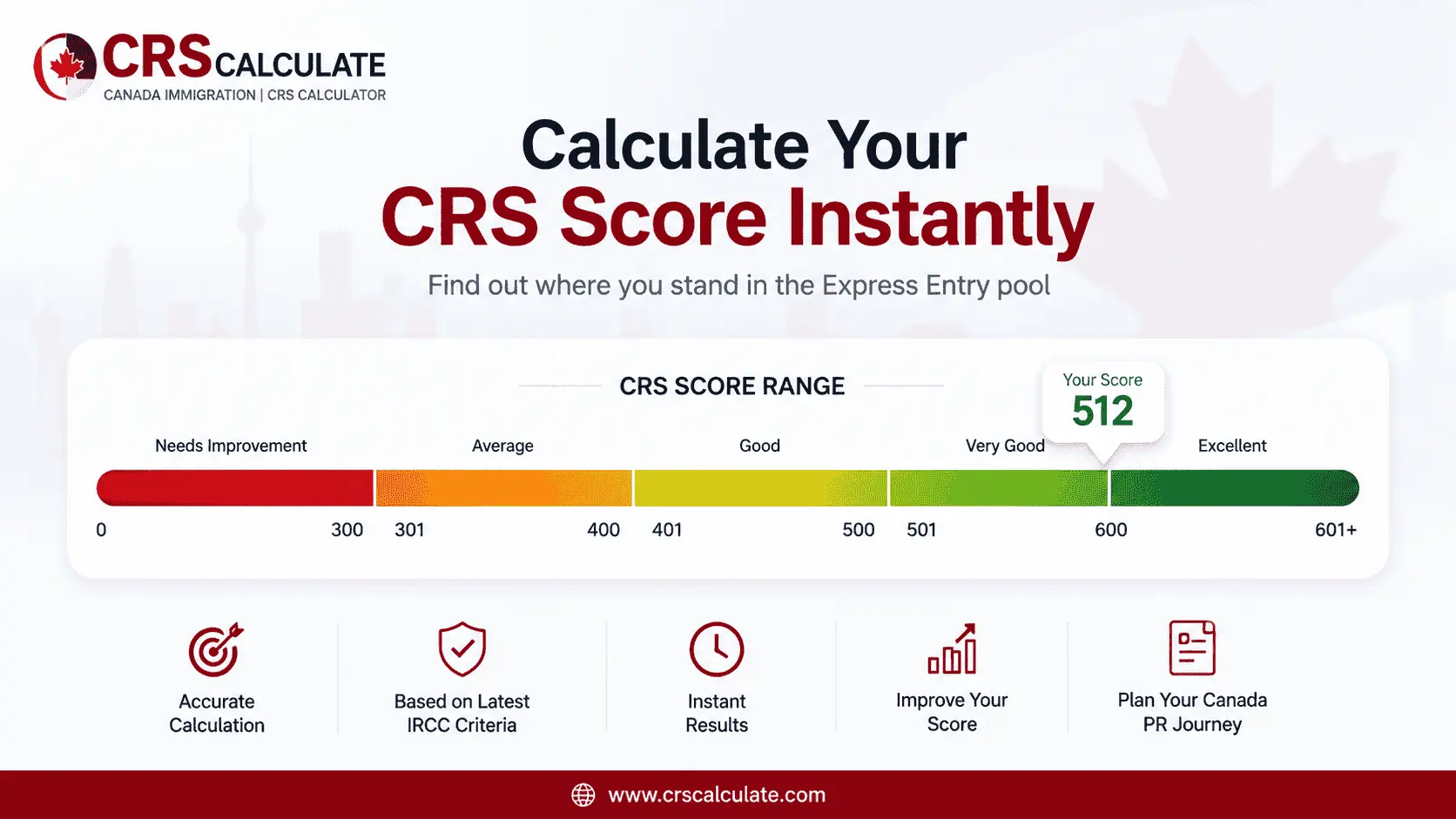
Those points or scores which an applicant get as a result of the factors his/her profile shares against the points based comprehensive ranking system is called CRS score. The CRS score is calculated based on different factors in which each factor carries a specific points. These factors are education, skills, language proficiency, work experience and others.
In order to get Invitation to apply(ITA) for permanent residency(PR) in Canada, your score should be higher than the minimum score of your round of invitation. Therefor, the higher the score the higher is the chance to get ITA. The CRS calculator calculates your score based on age, education, work experience, and language skills.
How to Use the CRS Score Calculator
Our CRS score calculator helps you accurately calculate your PR points by following the exact rules set by the IRCC for Canada Express Entry. All you need to do is fill out the required questionnaire, which collects information such as your age, education, skills, language proficiency, marital status, work experience, and more.
When to Use This Tool
Use the CRS calculator if you’re eligible for the Express Entry program or if you want to check your CIC(Citizenship and Immigration Canada) score before creating and submitting your profile. You can also use it after receiving an invitation to apply for permanent residency in Canada, to ensure your CRS score did not dropped due to changes in your profile.
About the Comprehensive Ranking System(CRS)
The Comprehensive Ranking System is a points based system that is used in the Canada’s Express Entry pool. It is created to assess and rank the immigration applicant’s profile against some factors, such as, age, education, skills, language proficiency, work experience and others. In order to get Invitation to apply(ITA) for permanent residency in Canada, there is no known fixed score points. Therefor, the higher the CRS score the higher the chance to to get ITA. These points can be calculated using the CRS calculator.
CRS Calculator Points Breakdown: How CIC Scores Are Allocated
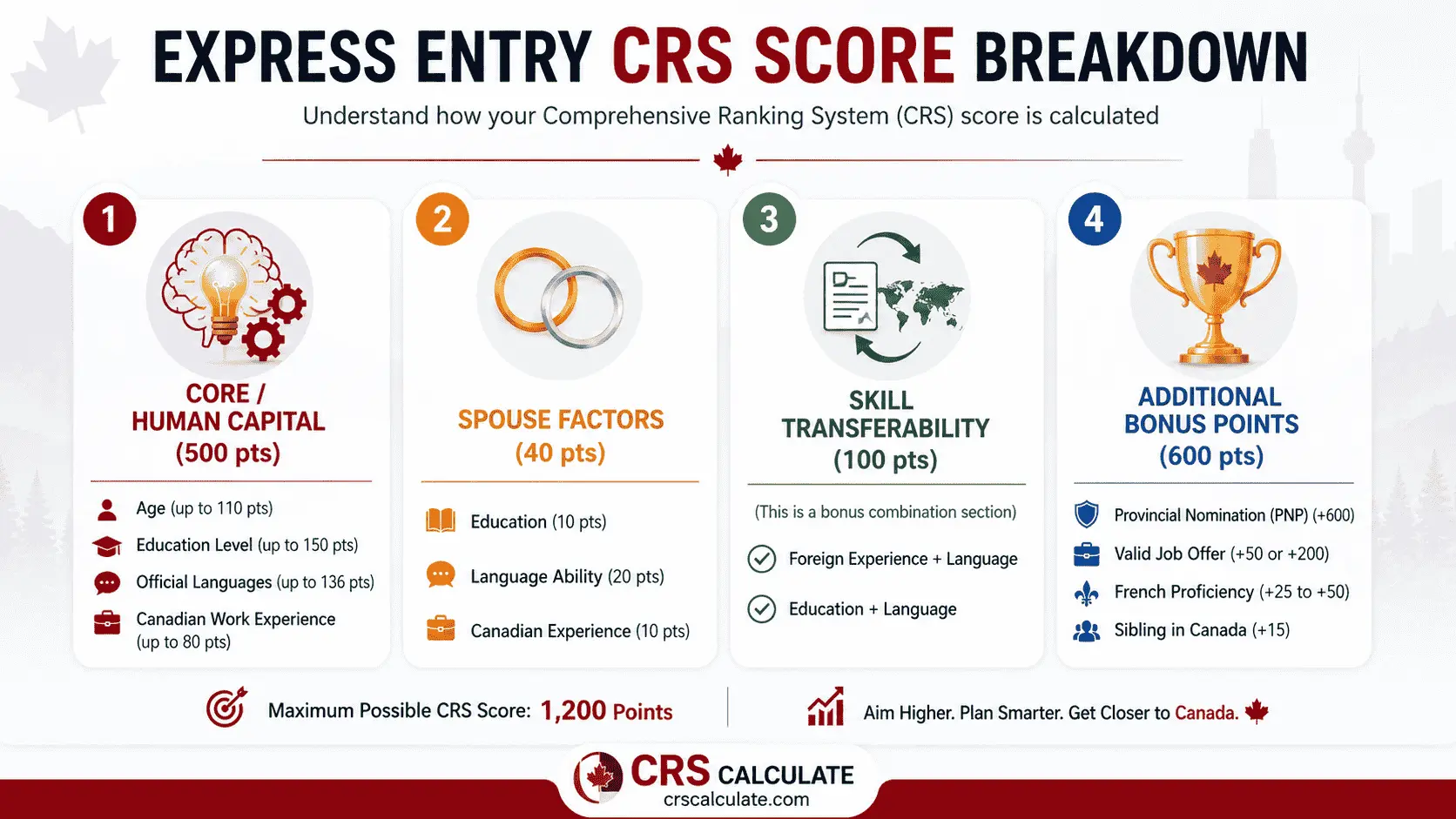
There is a grand total of 1,200 points available in the Express Entry points-based system, according to IRCC (formerly known as Citizenship and Immigration Canada – CIC) guidelines. There are few factors which carries a specific set of points during your CRS calculation. These factors are:
Core/Human Capital Factors
Spouse or common-law partner factors
Skill transfer-ability factors
Additional Points
A. Core/Human Capital Factors
For candidates with a spouse or common-law partner, there are: A maximum of 460 CRS points for the Core/human capital factors which include a maximum of; 100 points for age, 140 points for level of education, 150 points for official languages proficiency and 70 points for Canadian work experience.
For candidates without a spouse or common-law partner, there are: A maximum of 500 CRS points for the Core/human capital factors which include a maximum of; 110 points for age, 150 points for level of education, 160 points for official languages proficiency and 80 points for Canadian work experience.
Points Breakdown of Core/Human Capital Factors
| Age in Years | With spouse or common-law partner (Maximum 100 points) | Without spouse or common-law partner (Maximum 110 points) |
|---|---|---|
| 17 or less | 0 | 0 |
| 18 | 90 | 99 |
| 19 | 95 | 105 |
| 20 to 29 | 100 | 110 |
| 30 | 95 | 105 |
| 31 | 90 | 99 |
| 32 | 85 | 94 |
| 33 | 80 | 88 |
| 34 | 75 | 83 |
| 35 | 70 | 77 |
| 36 | 65 | 72 |
| 37 | 60 | 66 |
| 38 | 55 | 61 |
| 39 | 50 | 55 |
| 40 | 45 | 50 |
| 41 | 35 | 39 |
| 42 | 25 | 28 |
| 43 | 15 | 17 |
| 44 | 05 | 06 |
| 45 or more | 00 | 00 |
| Level of Education | With spouse or common-law partner (Maximum points = 140) | Without spouse or common-law partner (Maximum points = 150) |
|---|---|---|
| Less than secondary school(high school) | 0 | 0 |
| Secondary or high school diploma | 28 | 30 |
| One year post secondary (high) school credentials | 84 | 90 |
| Two years post secondary(high) school credential | 91 | 98 |
| Three year or more post-secondary credential | 112 | 120 |
| Bachelor’s degree OR a three or more year program at a university, college, trade or technical school, or other institute | 119 | 128 |
| Master degree | 126 | 135 |
| Doctoral (PhD) degree | 140 | 150 |
| Canadian Language Benchmark (CLB) level per ability | With a spouse or common-law partner (Maximum 128 points) | Without spouse or common-law partner (Maximum 136 points) |
|---|---|---|
| Less than CLB 4 | 0 | 0 |
| CLB 4 or 5 | 6 | 6 |
| CLB 6 | 8 | 9 |
| CLB 7 | 16 | 17 |
| CLB 8 | 22 | 23 |
| CLB 9 | 29 | 31 |
| CLB 10 or more | 32 | 34 |
| Canadian Language Benchmark (CLB) level per ability | With a spouse or common-law partner (Maximum 22 points) | Without spouse or common-law partner (Maximum 22 points) |
|---|---|---|
| CLB 4 or less | 0 | 0 |
| CLB 5 or 6 | 1 | 1 |
| CLB 7 or 8 | 3 | 3 |
| CLB 9 or more | 6 | 6 |
| Canadian work experience | With spouse or common-law partner (Maximum 70 points) | Without spouse or common-law partner (Maximum 80 points) |
|---|---|---|
| None or less than a year | 0 | 0 |
| 1 year | 35 | 40 |
| 2 years | 46 | 53 |
| 3 years | 56 | 64 |
| 4 years | 63 | 72 |
| 5 years | 70 | 80 |
B. Spouse or Common-Law Partner Factors (if applicable)
There are a maximum of 40 PR points for a candidate with a spouse or common-law partner who are coming along with him/her to Canada. 10 points for level of education, 20 points for official language proficiency, 10 points for Canadian work experience.
Points Breakdown of Spouse/Common-Law Partner
| Spouse’s or common-law partner’s level of education | With spouse or common-law partner (Maximum 10 points) | Without spouse or common-law partner (Does not apply) |
|---|---|---|
| Less than secondary school (high school) | 0 | N/A |
| Secondary school (high school graduation) | 2 | N/A |
| One-year program at a university, college, trade or technical school, or other institute | 6 | N/A |
| Two-year program at a university, college, trade or technical school, or other institute | 7 | N/A |
| Bachelor’s degree OR a three or more year program at a university, college, trade or technical school, or other institute | 8 | N/A |
| Two or more certificates, diplomas, or degrees. One must be for a program of three or more years | 9 | N/A |
| Master’s degree, or professional degree needed to practice in a licensed profession (medicine, veterinary medicine, dentistry, optometry, law, chiropractic medicine, or pharmacy) | 10 | N/A |
| Doctoral level university degree (PhD) | 10 | N/A |
| CLB level per ability (reading, writing, speaking and listening) | With spouse or common-law partner (Maximum 20 points for section, maximum 5 points per ability) | Without spouse or common-law partner (Does not apply) |
|---|---|---|
| CLB 4 or less | 0 | N/A |
| CLB 5 or 6 | 1 | N/A |
| CLB 7 or 8 | 3 | N/A |
| CLB 9 or more | 5 | N/A |
| Spouse’s Canadian work experience | Maximum 10 points | Without spouse or common-law partner (Does not apply) |
|---|---|---|
| None or less than a year | 0 | N/A |
| 1 year | 5 | N/A |
| 2 years | 7 | N/A |
| 3 years | 8 | N/A |
| 4 years | 9 | N/A |
| 5 years or more | 10 | N/A |
C. Skill Transfer-ability Factors
There are a total maximum of 100 PR points for skill transfer-ability factors which include: a maximum of 50 points for education with good/strong official languages proficiency (Canadian Language Benchmark [CLB] level 7 or higher) and a post-secondary degree; a maximum of 50 points for education with Canadian work experience and a post-secondary degree; a maximum of 50 points for good/strong official languages proficiency and foreign work experience; a maximum of 50 points for Canadian work experience and foreign work experience; a maximum of 50 points for good/strong official languages proficiency and a certificate of qualification.
Points Breakdown of Skill Transfer-ability Factors
| Education with good official language proficiency (CLB 7 or higher) and a post-secondary degree | Points for CLB 7 or more on all first official language abilities, with one or more under CLB 9 (Maximum 25 points) | Points for CLB 9 or more on all four first official language abilities (Maximum 50 points) |
|---|---|---|
| Secondary school (high school) credential or less | 0 | 0 |
| Post-secondary program credential of one year or longer | 13 | 25 |
| Two or more post-secondary program credentials AND at least one of these credentials was issued on completion of a post-secondary program of three years or longer | 25 | 50 |
| A university-level credential at the master’s level or at the level of an entry-to-practice professional degree for an occupation listed in the National Occupational Classification matrix at Skill Level A for which licensing by a provincial regulatory body is required | 25 | 50 |
| A university-level credential at the doctoral level | 25 | 50 |
| Education with Canadian work experience and a post-secondary degree | Points for education + 1 year of Canadian work experience (maximum 25 points) | Points for education + 2 years or more of Canadian work experience (Maximum 50 points) |
|---|---|---|
| Secondary school (high school) credential or less | 0 | 0 |
| Post-secondary program credential of one year or longer | 13 | 25 |
| Two or more post-secondary program credentials AND at least one of these credentials was issued on completion of a post-secondary program of three years or longer | 25 | 50 |
| A university-level credential at the master’s level or at the level of an entry-to-practice professional degree for an occupation listed in the National Occupational Classification matrix at Skill Level A for which licensing by a provincial regulatory body is required | 25 | 50 |
| A university-level credential at the doctoral level | 25 | 50 |
| Years of experience | Points for work experience + CLB 7 or more on all first official language abilities, one or more under 9 (maximum 25 points) | Points for foreign work experience + four first official language abilities CLB 9 or more (Maximum 50 points) |
|---|---|---|
| No foreign work experience | 0 | 0 |
| 1 or 2 years of foreign work experience | 13 | 25 |
| 3 or more years of foreign work experience | 25 | 50 |
| Years of experience | Points for foreign work experience + 1 year of Canadian work experience (maximum 25 points) | Points for foreign work experience + 2 years or more of Canadian work experience (Maximum 50 points) |
|---|---|---|
| No foreign work experience | 0 | 0 |
| 1 or 2 years of foreign work experience | 13 | 25 |
| 3 or more years of foreign work experience | 25 | 50 |
| Certificate of qualification (trade occupations) — With good official language proficiency (CLB 5 or higher) | Points for certificate of qualification + CLB 5 or more on all first official language abilities, one or more under 7 (Maximum 25 points) | Points for certificate of qualification + CLB 7 or more on all four first official language abilities (Maximum 50 points) |
|---|---|---|
| With a certificate of qualification | 25 | 50 |
D. Additional Points
Apart from the other factors there are four additional factors which boost your CRS score in Express Entry. You can earn a maximum of the following additional CRS points in the express entry pool: 15 points for your sibling who is a Canadian citizen or permanent resident living in Canada; 50 points for demonstrating strong French language proficiency; 30 points for completing post-secondary education in Canada; 600 points in case of receiving a provincial or territorial nomination under a Provincial Nominee Program (PNP), e.g., the Alberta Advantage Immigration Program (AAIP).
These additional PR points can dramatically boost your profile in the express entry pool and improve your chances of getting an invitation to apply(ITA) for permanent residency.
Breakdown of Additional Points
| Additional points | Points |
|---|---|
| Brother or sister living in Canada who is a citizen or permanent resident of Canada | 15 |
| Scored NCLC 7 or higher on all four French language skills and scored CLB 4 or lower in English (or didn’t take an English test) | 25 |
| Scored NCLC 7 or higher on all four French language skills and scored CLB 5 or higher on all four English skills | 50 |
| Post-secondary education in Canada – credential of one or two years | 15 |
| Post-secondary education in Canada – credential three years or longer | 30 |
| Provincial or territorial nomination | 600 |
CRS Calculator related FAQs
Has Canada removed job offer points from Express Entry?
As of March 25, 2025, IRCC has removed the additional CRS points for job offers in Express Entry. This means job offers no longer contribute to your CRS scores under Express Entry.
How Does the CRS score calculation work?
The CRS calculator scores your profile based on the points you acquire for each factor, which has a set of points according to the IRCC rules. After completing the questionnaire by answering each question, the tool provide you with a total sum of the points which is called CRS score. This is how the CRS calculator works.
What factors affect my CRS score in the Express Entry system?
Several factors influence your CRS score, including age, level of education, official language proficiency, Canadian work experience, foreign work experience, French language skills, having a sibling in Canada, and provincial or territorial nomination.
What is a good CRS score to receive an ITA (Invitation to Apply)?
A good CRS score is typically one that meets or exceeds the cut-off in recent Express Entry draws. The required score can vary depending on the type of draw — for example, Provincial Nominee Program (PNP) draws often require higher scores, while category-based draws may have lower thresholds. In the 2025 draws, the lowest CRS cut-off was:
- 379 in a French-language draw
- 699 in a PNP-specific draw
The highest CRS cut-off recorded was:
- 542 in a Canadian Experience Class draw
- 855 in a PNP-specific draw
These figures show how much the required CRS score can fluctuate, so keeping your profile as competitive as possible is key.
How can I increase my CRS score?
Here are some high value factors through which you can improve your CRS score and boost your express entry profile:
- IELTS CLB 9: Earn up to 136 CRS points by achieving CLB 9 or higher in the IELTS test.
- French Language: Score up to 50 additional points with strong results in an approved French language test, especially when paired with strong English scores.
- Provincial Nomination: Get 600 bonus CRS points through programs like OINP or other PNPs.
- Skill Transferability Combos: Pairing strong language scores with Canadian work experience or education can add up to 50 more CRS points.
- Canadian Education: Completing a diploma or degree in Canada gives up to 30 PR points.
- Spouse/Partner Factors: Include your spouse or common-law partner to gain up to 40 additional PR points.
- Canadian Work Experience: Get up to 80 CRS points with 5 years or more of Canadian work experience.
How accurate is CRS calculator?
This CRS score calculator gives you a pretty good estimate of what your profile’s CRS score would be in the express entry pool. However, any CRS calculator is not always 100% accurate because some factors can influence the uncertainty in the CRS score — like entering the wrong information in the tool, not being sure of your job offer, or changes in the IRCC rules. However, this tool is build according to the updated rules published by IRCC as of March 25, 2025.
How often does the CRS score cutoff change?
The CRS score cut-off changes with each draw in the express entry pool which happens after every two weeks. However your profile score will not alter if you do not update your profile in the express entry pool. Stay up to date with the latest Express Entry draws and CRS cut-off trends on our CRS and immigration updates page.
How much CRS score is required for Express Entry?
There is no specific known CRS score for the express entry which will make you eligible for receiving ITA(Invitation To Apply) in Canada. As the cut-off score changes in each draw which happens after every two weeks. Therefore, the higher the CRS score the greater is the chances to receive an ITA from the IRCC. As per 2025, the CRS score of 500 and above is considered a good number.
How to check CRS score calculator?
You can use our CRS calculator to check your estimated score for the express entry.
How long is my CRS score valid in the Express Entry pool?
Your CRS score is valid up to 12 months after you submit your profile in the express entry pool. If you don’t receive an ITA within this time period, you will need to resubmit your profile again in the express entry pool.
What Is Foreign Work Experience in the PR Points Calculator?
In the context of Canada’s PR points calculator, foreign work experience refers to the skilled work completed outside the Canada, typically in the last 10 years of duration. It contributes to your CRS score based on the factors like job classification (NOC), duration and relevance your Canadian immigration stream.
Does my spouse affect my CRS score?
Yes, Your spouse or common-law partner can affect your CRS score in express entry if you mention it in your profile. Your spouse can contribute up to 40 additional points in these areas:
- Spouse’s language skills: Up to 20 points
- Spouse’s education: Up to 10 points
- Spouse’s Canadian work experience: Up to 10 points
Include your spouse’s language skills, education, and Canadian work experience in the CRS calculator to get an updated score.
How does Canadian education affect your CRS score in the Express Entry calculator?
If you study 2 years full time in Canada, you can gets 5 to 15 points under “Canadian Education” category depending on the duration and level. If you have spouse or common-law partner that is accompanying you to Canada you can get a maximum of 10 CRS score for it depending on the highest level of education. Also, some provinces prefers candidates with Canadian education for the provincial nomination program, getting you 600 extra CRS points.
Can I calculate my CIC Score before applying for Express Entry?
Yes, you can calculate your CIC Score before applying for Express Entry by using an online CIC score calculator. This helps you estimate your eligibility and understand the comprehensive ranking system. Knowing your score in advance using a CRS calculator, get you a clearer idea of how competitive your profile is for Express Entry pool.
This article contains public sector information sourced from the Government of Canada, Immigration, Refugees and Citizenship Canada (IRCC), and is licensed under the Open Government Licence – Canada. For more detailed information, visit the official IRCC CRS calculator page.